Sustained Definitions Within Social Media
- emily souza

- Jan 14, 2019
- 12 min read
Updated: Jun 12, 2021
Studying the sustained definitions within the term “Social Media” and it’s usage between the years of 2004-2019.
Emily Souza
Abstract
This article examines the sustained definitions of the term “social media” and the connotations and understandings that come along with it, as well as how the term has changed throughout the years 2004-2019. Social media has become a multi-faceted tool to market product, voice opinions, and connect with others.
Introduction
In recent years, social media and the consumption of media across online platforms has skyrocketed as users have been able to have the opportunity to become co-creators within these platforms. The introduction of co-creators creates “user-generated content as content that has three main features: is made publicly available online, reflects some creative effort on the part of the user, and is created outside professional practice. User-generated content encompasses many forms, ranging from videos, photos, blogs, and vlogs...consumers have embraced media democracy and the industry has responded by creating and encouraging consumers to create and co create context.” (Tuten, 2017.) Given the new opportunities users have as co-creators within social media, social media use has increased and the context in which we understand social media has changed.
“Social media”, has been most recently defined as “forms of electronic communication (such as websites for social networking and microblogging) through which users create online communities to share information, ideas, personal messages, and other content (such as videos).” (Merriam-Webster, 2019.)
Within this genre of Social Media, and the new technological advances we have seen in the past 15 years, the usage of the term “social media” and the correlations that come along with the description and understanding of the term has changed.
The purpose of this study is to indicate a gap in research in studying the sustained definitions of the term “social media” and the implications around it. I will help to further bridge this gap by indicating some initial observations within the study.
Studying the sustained definitions of the term “social media” can help readers and users alike to better understand what can be expected when one hears or uses the term “social media”, and what that entails. Because of the instantaneous and constant changes within the genre, the term continues to be re-defined.
In this study I will be researching the applied linguistics around the term “social media”. And within the genre of applied linguistics, specifically sustained definitions. Applied linguistics studies “what we know about language, how it is used, and how it is learned.” (Karavas, 2014.) Sustained definitions can be defined as “how words are used by communities, rather than committing the writer (and reader) to a particular use of the term. ( Giltrow, et. al., 2014.)
Halliday (1994: 225) discusses this kind of propositional expansion as a semantic relationship of elaboration, where ‘one clause elaborates on the meaning of another by further specifying or describing it’. (Hyland, 2007.) This quote was originally used in terms of code glosses, but may also be applied to sustained definitions.
In this article, I will be comparing and contrasting the term “social media” and how it’s usage had been studied and applied in context of academic journal articles, within the years of 2004-2019; breaking up these years into two groups; from 2004-2011, and from 2012-2019.
Within these two groups we see differences in how the term social media is used, because of its introduction, explosion and take-off around the year of 2004, (Facebook, 2019., Google Trends, 2019.) and exponential growth in use over time. The reasoning for this time period of research refers to the explosion of co-creation of the Web 2.0 which was popularized in 2004. (Wikipedia, 2019.) This research is conducted beginning in the year of 2004 to the present year of 2019, to research sustained definitions within social media, in the era of Web 2.0.
The nature of this type of media is that people can consume, produce, acquire, and process information- quickly and interactively. As social media use has increased, how users are able to do this has inevitably altered.
My hypothesis for this study, is that social media use towards the latter years within this study will be seen and used more frequently and more widely. Within this study, the findings conclude that social media has progressed from the years 2004-2019, and it’s uses increase as the technology has advanced within this genre.
Key words:
-social media - old media - social media platforms
-social media use - new media
Methods
The objective of this study is to analyze sustained definitions within social media as well as the trends in analytics of “social media” to continue to prove its progression of use in time. The sustained definitions of social media are also being researched to help define what social media was and currently is. In order to further understand how this works, and to collect data, I will be gathering 30 articles relating to and including the term “social media” from the years 2004-2019 that will be included in my corpus.
From there, I will be be placing the research into two groups, those from the year of 2004-2011, and from 2012-2019; I will analyze and describe the differences and similarities of how “social media” is defined and described in each of these, in regards to sustained definitions.
Using these articles, we can observe how language is being changed around the topic and term of “social media” and the sub-genres within social media that may be included.
By analyzing this research and collecting this data, we will be able to see this data entry visually in a line graph form, to see the differences in search popularity the term “social media” throughout these specific years. This search, helps us indicate not only searchers of this who used social media, but also how many searched “social media” for the meaning of the term.
By studying these two graphs of social media usage over time, we can indicate that there is an increase in usage over time within both of these graphs.
I have also created a table to show the sustained definitions comparatively of each article within the corpus. This shows the similarities and differences within sustained definitions from the years 2004-2019 and how they compare and contrast. We can also see how popularity and use of the term changes over time by analyzing the data and language used within these journal articles to determine how the term is seen and described over time.
Within the corpus, all articles were selected from the Communication and Mass Media Complete Database, located through the Fogler Library at the University of Maine.
Within each research article, I searched the term “social media” and located the sustained definition for each article. Next, I quoted what each article has defined social media as, and added it to my corpus.
In this study there are two groups of years that I am going to be comparing and contrasting. Group A will be referring to the studies and findings of the term “social media” within primary research articles from the years of 2004-2011.
Group B will be referring to the studies and findings of the term “social media” within primary articles from the years of 2012-2019. These groupings will assist in keeping information compact, and comprehensible within the study and article.
Group A - Research From Years 2004-2011
In Group A, I had found that multiple academic articles chose and used words such as “adoption”, “familiarity”, and “participation”, when referring to social media usage.
Barnes refers to social media as something to adopt. “ [the] adoption of social media over three years” (Barnes, et. al., 2009.) was used, referring to social media as a marketing technique that companies were going to put on trial; indicating that this was a new technology and users [in this case within the corporate field] were skeptical.
The same article later states that social media “penetrated” with “tremendous speed.” (Barnes, et. al., 2009.) The usage and word choice of “penetrated” and “tremendous speed”, infers that social media was something that was successful within marketing once users were comfortable and used to using these platforms to communicate.
Hathi writes, “Social media has not been a passing fad for 2006.” (Hathi, 2007.) By analyzing the term “fad” we can see between the lines using applied linguistics, that users were skeptical, but the marketing technique of social media was successful, unlike a fad- which passes.
Social media during the time of Group A, may also be referred to as “new media” in comparison to “old media”, which refers to newspaper, and television- as conducted ways to disperse media- without the content or participation of co-creators.
“..between traditional and new media, as well as the role that Social Media have in promoting written press and improvement of interaction between written press consumers or online, but also between readers and journalists.” (Tasenţe, et. al., 2011) Tasenţe goes on to use the words “reorient” and “transforming” in relation to social media. (Tasenţe, et. al., 2011)
By studying the linguistics we see here, as we go from “old media” to “new media”, there is some hesitation as well as anticipation within this new genre of communication. We observe social media being defined within the usage of corporate business, specifically marketing and advertisement. Polson chooses the words identity, processes, and perceived. (Polson, 2011.)
Social media here, is used in terms of brand identity; seeing that social media’s role can help further perspectives and processes within building and maintaining brand identity and formation.
Barnes references Social Media and the platforms under that umbrella at the time as “ blogging, podcasting, online video, social networking, message boards, and wikis.” (Barnes, et. al., 2009.) Segerberg, et. al., refers to social media as “organizing mechanisms.” (Segerberg, et. al., 2011) In which users can help to organize data. Audience activity, creativity, and profitable are phrases that Gallant, et. al,. uses. (Gallant, et. al., 2011) Verdegem introduces concepts around social media and uses terms such as “Potential, relationship, reflect, contribute, digital and social inclusion.” (Verdegem, 2011.) to relate to social media and its effects within relationships and consumers.
When reaching out to users the members of the ICA conference choosed “Credibility, initiating, engagement, effectiveness.” (ICA Conference, 2010.) as key words to describe outreach within social media. Taske refers to social media as a phenomenon, valuable, and powerful” (Taske, et. al., 2011) Cheong again uses the word adopt, as well as potential, and interactive within regards to the use and advancement of social media. (Cheong, 2011)
Mersham uses key terms such as reference, awareness, shared, and explored (Mersham, 2010.) to point attention to how information is shared across platforms. Again, we see this with Kushin; as he uses attention, online expression, involvement. (Kushin, 2010) within his article to articulate how information is shared.
Avery uses terms such as agreement, accuracy, congruency. (Avery, 2010.) to emphasize the importance of truth within factual information sharing on the internet. The International Communication Association speaks of engagement (within terms of social media), relational satisfaction, relational commitment. In regards to users and despursing information. (International Communication Association. 2011)
Within regards to user information and information distribution techniques we see linguistics such as influence, perception, avert. (Kerkhof, 2011.) and strategic framework, and targeting. (Dodd, 2011.)
Group B - Research From Years 2012-2019
In the second grouping of years; we see social media described differently. Rather than with apprehension, social media is described in appreciation. Van Dijck, et. al., uses the words “penetrated”, “affecting” and “interactions” (Van Dijck, et. al., 2013.) We see here that the way that social media was referred to and connotated within both personal and business lives is still present within studying Group B.
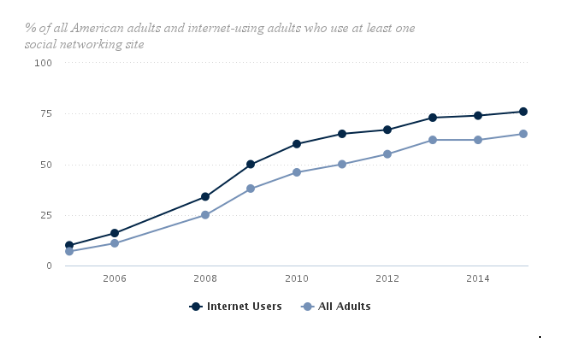
In Group B, by this quote we already see the difference in social media and how rapidly it has become a tool in users daily lives. Nearly two-thirds of American adults (65%) use social networking sites, up from 7% when Pew Research Center began systematically tracking social media usage in 2005. (Perrin, 2015.) “Social media are digital platforms that facilitate information sharing, user-created content, and collaboration across people (Elefant, 2011). Social media include networking sites such as Facebook, YouTube, and LinkedIn (Kaplan & Haenlein, 2010; Lenhart, Purcell, Smith, & Zichuhr, 2010).” (Perrin, 2015.)
This technology has revolutionized the way people connect, communicate, and develop relationships.” (McFarland, 2015.) Here we see a different description of what falls under the umbrella of “social media”, as these platforms such as Facebook, and LinkedIn have now developed and most of them are sites that co-create with the user are more social and user based in term of personal use.
Seidman uses terms like form, maintain, fulfill, and belonging in regards to social media and online connection. (Seidman, 2012.) Within this new ideal of marketing, advertisers sought out the idea of identity and voice of brand and brought this to their marketing within social media. Grewal uses “enables” in relation to social media (Grewal, et. al., 2019.). This tool now has given people great opportunities. Guo uses terms such as ubiquity, interactive, and emerging to describe the influence of social media (Guo, 2018.)
Instant, audience perception, public discourse, and commentary are linguistics that Finneman uses to describe the influence of Web 2.0 involving the introduction of co-creators and users within social media. (Finneman, 2018.)Support, commentary, discourse, and stereotyping are linguistics that Dobson uses to refer to dialogue within social media. (Dobson, 2018.)
Galvez defines social media as evolution, and a technological revolution. (Galvez 2018.)
Enables, community, agency are the terms Luke uses to define social media. (Luke, 2018.) Skinner uses terms like identity creation, role, brand identity, and brand image to define social media. (Skinner, 2018.) Jin defines social media as a social phenomenon, with terms like desire, and obsession. (Jin, 2018.) Keats uses terms such as engagement, phenomenon, and digital construction to define social media. (Keats, 2018.)
Mudra defines social media with words such as opportunity, efficient, and promotion. (Mudra, 2018.) Promote, content, target advertising are terms that Kanuri, et. al., uses within their sustained definition of social media. (Kanuri, et. al., 2018)Rathnayake uses terms such as dynamics, consumption, and gratification to create a sustained definition of social media. (Rathnayake, 2018.)
We can see with the changes in the applied linguistics from group A to group B that the perception and mindset within social media and its implications has slightly changed. The ways to use social media over the years has increased, as well as its implications; this is present in the way that the sustained definitions of the term social media slightly change as the years progress.
Two graphs below show the increase within social media usage from the years 2004-2019. Within them we see an upwards trend within the search and use for these terms.
Graph 1:
Graph 1 shows the percentage of American internet using adults who use at least one networking site. This graph shows the usage data from the years approx. 2005-2016. (Perrin, 2015.)
Graph 2: (Google Trends, 2019.)
Graph 2 shows the term “social media” search popularity increase from the approx. years of 2004-2019.
By studying these two graphs of social media usage over time, we can indicate that there is an increase in usage over time within both of these graphs.

This table shows the articles studied within the corpus in order of year (2004-2019) showing the sustained definitions within each article, synonyms for each definition, and the comparison between each definition, in order to study the themes and word choice used in each and in the corpus as a whole.
Findings
Table 1:


Within this research we see the themes of involvement/belonging, adoption, discourse, promotion, perception, and phenomenon relating to social media most commonly within this corpus in studying sustained definitions around social media.
Conclusion
Overall, we see that the way the term social media and the implications that come with it have changed over time. By looking at the findings in Google Trends, and by researching 30 academic articles as well as the findings from secondary sources, the way that the public and society as a whole understands social media in the present time, versus 15 years ago, has changed drastically.
This research has shown through the study of applied linguistics that in the present, the public is much more trusting of social media and the internet in general, and for the most part; in western culture- social media and the technology that comes along with it has been implemented in our everyday lives; during work and personal life.
Many people rely on the applications that are within social media to connect with others in their personal and business affairs this is why the growth and trust of social media has grown substantially over time. Also there has been the birth of “Web 2.0 and the Participative Web: now implemented with User-Created Content.” otherwise known as the introduction of co-creators within these platforms. (Tuten, 2017.)
Within the introduction and explosion of the co-creator use within social media; there are however, some social limitations. “The logic of social media, as was previously the case with mass media logic, is gradually dissipating into all areas of public life; the cultural and commercial dynamics determining social media blend with existing commercial and advertising practices, while also changing them. Far from being neutral platforms, social media are affecting the conditions and rules of social interaction.” (Van Dijck, et. al., 2013).
While increased social media usage has its pros it also allows less monitoring of credible sources, adding to and creating information within these platforms. The concept of “Fake News” or the spread of false content “has been widespread concern that misinformation on social media is damaging societies and democratic institutions.” (Allcott, et. al., 2018.) Within this genre, misinformation can be dispersed within many genres, such as but not limited to: politics, health and mental health, education, and laws.
Most social media platforms have adapted to the needs of users, and within one platform there are multiple applications that can make the user experience much more enjoyable and worthwhile, since social media platforms continue to find ways to create applications and techniques within the platform to meet users needs. Social media use has drastically grown, and will continue to do so for years to come.
The sustained definitions within the corpus covered primarily the themes of involvement/belonging, adoption, discourse, promotion, perception, and phenomenon. Within these themes are subcategories, in which there is more research needed to be done within this genre of sustained definitions relating to social media. Overall, however, we see from the corpus and table that these themes are what researchers, users, and society overall defines social media as.
Comments